It started with poetry
I wrote it all the way through school. Dark, heavy, more interested in the thing nobody wants to say out loud than in sounding nice about it. It won a few awards, which I genuinely did not expect, and eventually it turned into lyrics — which is really just poetry that has to survive being sung.
I still write the same way. I like subjects people avoid, and I'd rather be uncomfortable and honest than polished and hollow. If a song of mine is comfortable, I've probably done it wrong.
Photography started in a darkroom
I got into it in high school. Took a class for it, back when we still had to develop pictures in a darkroom — and then, inside the darkroom, even tinier rooms, where you had to hope you could get your film out of the canister without destroying it. Complete darkness, with a partner fumbling in the dark somewhere next to you.
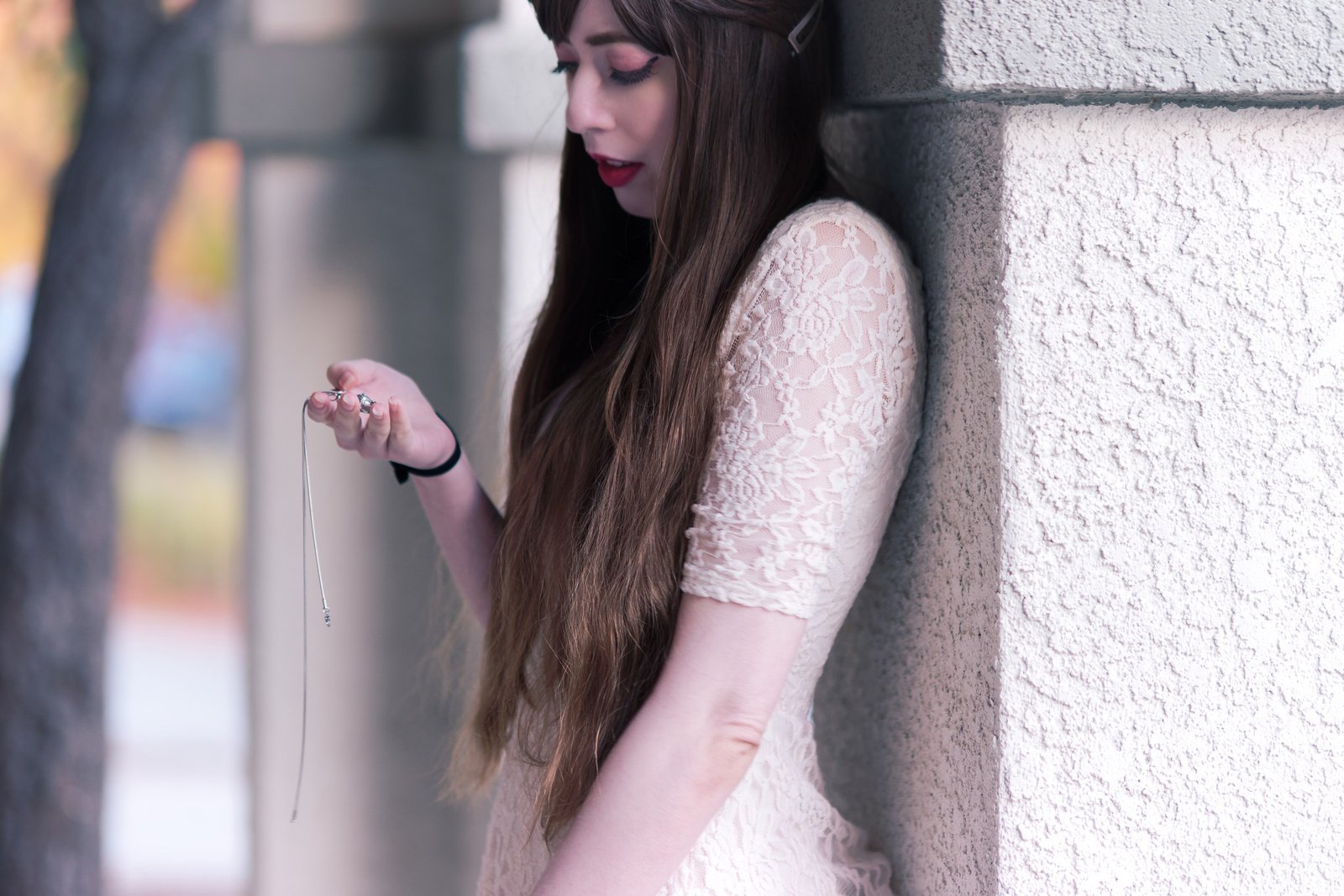
We had free reign of the school for the shooting side, and I tried creative things while developing to make pictures turn out a certain way. Eventually I got a digital camera as a gift, and grew to like portrait photography the most. I have a good eye for what looks nice — color especially — and I've always worked in natural lighting. Intuitively just knew what to do with it, from the start. I've since upped my camera equipment game, and I'm excited to keep developing as a photographer.
I also like taking candid pictures and telling emotional stories that way. But I also tend to feel somewhat guilty in the process.
Around that same era I was doing photomanipulation — signatures and banners, layered out of stock and screenshots. It taught me composition, how to make one image out of many, how to blend things that don't belong together. That's what set me up for compositing everywhere else, and it's a big part of what I bring to art direction.
Art direction is what happens when I listen to music
I've always kind of made movies in my head when I listen to music — any kind of music. I'd be in the passenger seat of a car, and I'd make a whole original movie by the time we got somewhere. I dream entire movies. That kind of thing made me really good at visualising the details, and at coming up with concepts that don't already exist.
I try to think of what hasn't been done, or what we could do better. I try to tug on the heart strings. I think I'm a good storyteller in general, and I think that's often what's lacking in artistic spaces. No matter what you're good at, you can't teach that — you either have it or you don't.
I also like making things really complex. I'm not afraid to aim for the stars.
I'm still doing the same thing now — currently learning 3D modelling from the ground up. Badly, and happily.
Where I learned to actually produce
I joined the Youtaite community at eighteen and started making vocaloid covers. That's where the shy kid who only ever sang alone figured out how to finish things and put them in front of people.
I've organised several groups since. Anemone focused on orchestral covers, frequently built on Morrigan's compositions, with vocalists I'm still proud to have worked with. Bacio Della Morte was short-lived but became a fan favourite on the strength of its story and its mashup arrangements. What both had in common is that I started them by looking at the space and noticing a gap. That's the thing I'm most reliably good at — being the person willing to make the thing nobody's made yet.
Those groups are also where I actually learned to arrange and direct. Highly layered vocal arrangements came first — the covers needed them, and I liked building them. Then directing the vocalists themselves: how a line should be delivered, where a voice belongs in the song, when the tone needs to shift. I'm good at vocal stylization — but the bigger thing is understanding how the placement of a specific word, the tone it lands in, and the shift between parts actually reach the person listening.
I sing pop and classical. Classical is my real timbre and always has been. My influences are Morrigan, Lily, Akiko Shikata, Kokia and Sam Smith, plus two friends — Rivynn and L'ouie — whose work has taught me more than most professionals have.
Mixing was the one I picked up on purpose
Vocaloid covers, ironically — I got into them because someone else wanted to and never actually started. I did. And pretty quickly I figured out I had a knack for the mixing side. I had a good ear. It was just something I needed to improve on naturally.
I started with Adobe Audition and learned the hard way what starting from scratch feels like. Multiple times. For the same song. I don't use Audition now. Studio One is my baby. I've also used Nuendo, Pro Tools, and Logic Pro. I try to keep up with the best tools of the trade across every medium — the newest VSTs, the newest plugins. I always want to see what's out there and how it could improve my workflow. I'm currently working through MIXXIN Academy's Music Production Certificate — 245 lessons across the whole production chain — and I've taken Streaky's courses too. He's the UK mastering engineer behind Ed Sheeran, Adele, and Skepta, among others.
I learned backwards, mixing groups of up to ten vocalists at once. By the time I actually understood what I was doing, I could handle situations most professionals can't.
The through-line is storytelling. Whatever the format, I'm trying to make you feel one specific thing, and I'll take a strange route to get there if the obvious one lands flat. In the mixing chair that means emotional presence over loudness, and layered, stacked vocals over clean and safe.
I can hear what isn't there yet
I've always had the ability to read people — strengths, weaknesses, potential. Not just what someone is now, but what isn't there yet, and what they don't know about themselves. That goes for artistic staff and vocalists both. I can tell where a person's voice would be if they did several things differently.
The same instinct is what I use when I'm picking who to work with. LittleJayneyCakes (264K subs, 57M+ views), Lollia (396K subs, currently featured on Helluva Boss), and Phoebe Chan (51K+ YouTube, active IRL idol career) are three I brought into projects early — before the numbers caught up to what I could already hear. Full record is on the Scouted Talent page.
I can also place multiple voices together in my head and hear exactly what they'd sound like if they were all in the room. I've always known which voices blend together naturally. Some people run blend tests. I do it in my head.
Animation, I had to figure out on the fly
Animation was different. It was missing from my projects, so I had to pick it up on the fly. I tried my best to make things visually interesting, and asked myself what was missing from other people's animation. Some of the more interesting choices came from working around what I didn't know yet.
What I'm looking for
Creative direction, art direction, video, audio, or writing — ideally somewhere that would rather have one person who can carry an idea from concept to finished file than four people passing it down a chain. Music, gaming and entertainment are where I'm most at home, but the skills travel.
I work remotely, I'm self-directed to a fault, and I'm at my best when I'm trusted with the whole arc of something rather than one slice of it.
Otherwise
I read constantly, mostly psychology and philosophy. I write. I stream. I hold six certifications across social media marketing, advertising, management and fashion design. I composite images at two in the morning more often than is reasonable.
And snacking, which I maintain is a legitimate hobby.
Based in Huntington Beach, California. Available for commissioned work and open to the right full-time role — get in touch.